On this page
Fago Textile buyer guides · 17 October 2026
What does hoodie fabric GSM tell a buyer?
Hoodie fabric GSM is the mass of one square metre of fabric, expressed in grams. It helps define a purchasing specification, but it does not describe the complete garment. Two fabrics with the same GSM can differ in construction, composition, surface finish, width and feel. Choose a weight through sample comparison and a garment trial, then document the approved result.
For bulk hoodie production, start with the intended use: an easy layering garment, a structured oversized silhouette or another defined product. Give the supplier a reference sample and explain which features matter. Our hoodie and sweatshirt fabric options provide a starting point for that discussion.
1. Pair hoodie fabric GSM with the construction
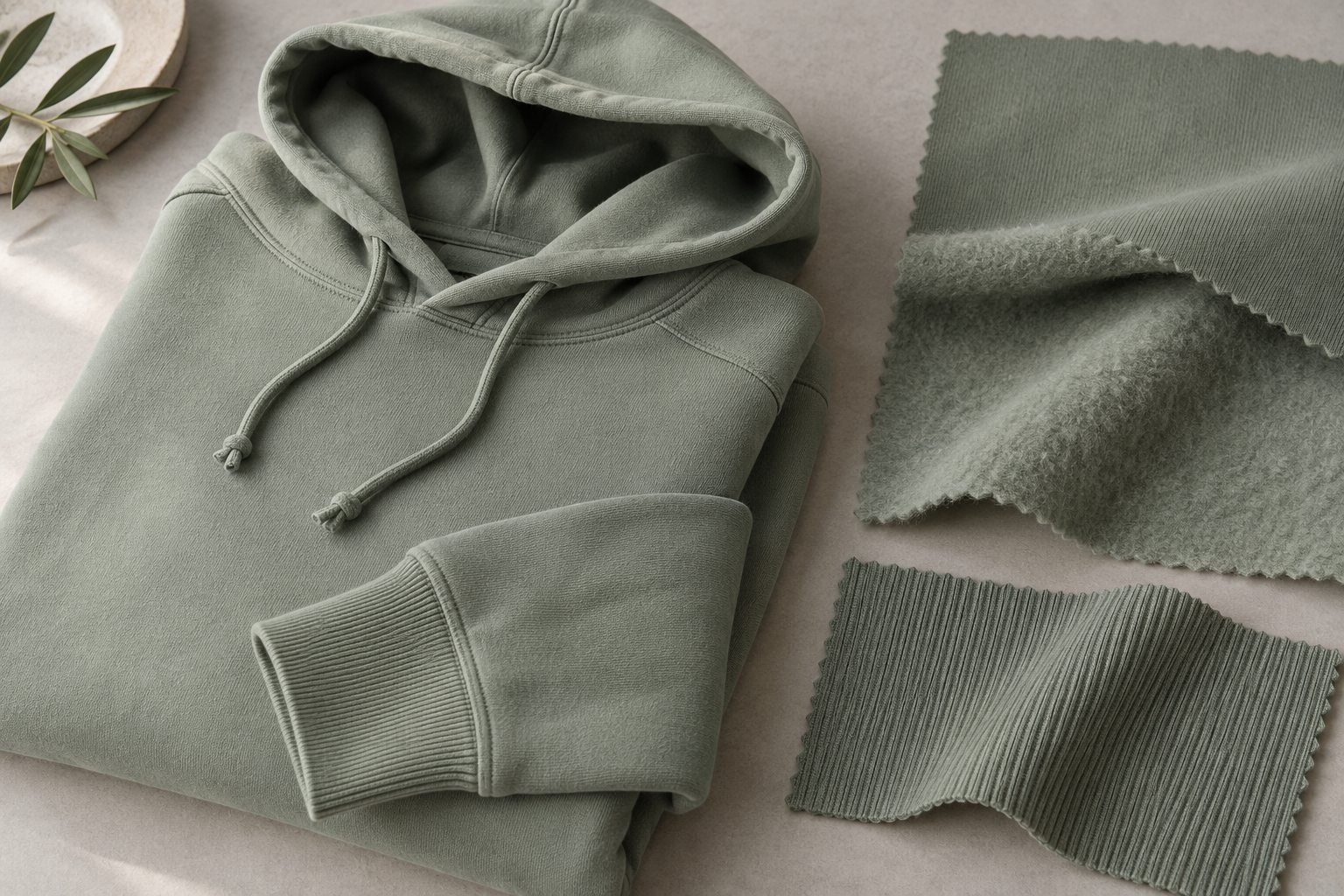
Confirm whether the brief calls for an unbrushed reverse or a brushed surface before comparing weight. CottonWorks describes French terry and fleece constructions and explains how napping the reverse distinguishes a brushed finish. Its single and double knit reference is useful background for the terminology.
Request samples of the relevant French terry or three-thread fleece construction. State the fibre percentages and desired finish alongside hoodie fabric GSM. Do not approve an alternative simply because the weight matches; compare the face, reverse and handling of the actual samples.
2. Test the intended garment, not a loose swatch alone
Ask your development team to make a representative garment from the proposed sample. Examine the hood, pocket opening, shoulder line, seams and hem with the intended pattern and components. Include any lining or double-layer hood in the trial because the complete assembly is what the wearer experiences.
A heavier swatch is not automatically the right choice for every silhouette. Use the trial to assess drape, bulk at joined layers and the result of the intended decoration. Review the garment again under the agreed care procedure. The goal is a repeatable approval, not a universal “best” number.
Record hoodie fabric GSM as one field in the approval sheet. Keep observations about softness, shape, surface appearance and construction as separate decisions so a weight result cannot hide a problem elsewhere.
An example of a useful sample comparison
The following is an illustrative development exercise, not a list of Fago Textile stock weights or performance guarantees. A buyer could request three samples at nominal 280, 320 and 360 GSM, with the same agreed construction, composition and finish, then compare garments made from each.
| Keep consistent | Record for each sample |
|---|---|
| Garment pattern and size | Fit, drape and finished garment mass |
| Composition and surface finish | Face and reverse appearance |
| Hood, pocket and seam construction | Bulk and sewing observations |
| Agreed care procedure | Dimensional change and appearance |
Change one variable at a time where practical. If a sample also changes the blend or finishing process, mark it as a different material option rather than attributing every difference to GSM. Confirm which proposed weights the supplier can actually offer.
3. Specify finished weight and the acceptance basis
Write the target hoodie fabric GSM into the finished-fabric specification. Ask the supplier and your technical team to agree the sampling and measurement conditions, the tolerance and the reporting format. A nominal target without an agreed tolerance does not explain how a production lot will be accepted.
Link every test report to an article, colour and lot. Use consistent conditions when comparing results and ask for clarification if reports use different bases. Our fabric GSM guide explains the purchasing terminology; the bulk fabric quality checklist helps organise the other approval requirements.
4. Include usable width and garment yield
Fabric consumption depends on the cutting plan as well as weight. Ask for the finished usable width and confirm whether the fabric is delivered open width or tubular. Have the cutting room compare marker yield at the proposed width before selecting an offer on price alone.
For a theoretical example, 320 GSM open-width fabric at 1.80 metres total width weighs 0.576 kg per linear metre: 320 × 1.80 ÷ 1,000. This is an arithmetic illustration, not a guaranteed roll measurement. Cutting allowances, unusable edges and the agreed quantity basis still need to be considered.
When comparing hoodie fabric GSM alternatives, use our fabric cost conversion guide to align quotation units. Then compare the complete material requirement per garment, including matching components, rather than assuming the lowest kilogram price gives the lowest product cost.
5. Approve matching rib and repeat-order details
Define cuffs, waistband and any neck trim as separate components. Ask for suitable rib fabric samples and check their appearance and behaviour with the chosen body fabric in a sewn trial. Share the same colour references and record separate sample identifiers.
Before ordering in bulk, send quantities by colour and component, the approved hoodie fabric GSM, destination and requested release dates. Separate confirmed orders from future forecasts. For repeat programmes, keep the signed-off fabric and garment references available for the next production discussion, and identify any requested change before the next lot is approved.
Hoodie fabric GSM: buyer questions
Is 400 GSM always better than 300 GSM?
No. A higher number means more mass per square metre, not automatic superiority. Compare the proposed construction, finish and completed garment against your product brief.
Can GSM alone tell me how warm a hoodie will feel?
No. It is not a complete warmth specification. Evaluate the material and garment construction for the intended use, and request relevant testing where the product brief requires measured performance.
What information is needed for a bulk hoodie fabric quote?
Provide construction, composition, finished GSM, width, finish, colour quantities, matching rib requirements and destination. Include a reference garment or swatch if you have one.
Discuss your bulk hoodie fabric specification.
Send your fabric specification, quantity per colour and delivery destination. Discuss samples, wholesale orders and recurring supply with our sales team.